
The Executive Paradox: Why Being Busy Isn't the Same as Being Effective
You're drowning in tasks. Your calendar is packed from 7 AM to 7 PM. Your inbox never reaches zero. And yet, at the end of each week, you struggle to point to the strategic progress that actually moves your organization forward.
You're not alone. Research shows that executives spend roughly 41% of their time on activities that could be handled by someone else or eliminated entirely. That's nearly two full days every week spent on low-impact work while your most important strategic initiatives languish in your "someday" folder.
The culprit? What psychologists and productivity researchers call the urgency trap: the seductive belief that because something is urgent, it must be important. Your phone rings. Your inbox pings. A crisis emerges. And suddenly, your carefully planned strategy for the quarter gets shelved while you firefight another emergency.
President Dwight D. Eisenhower faced this exact problem. As Supreme Allied Commander and later as President, he had to manage competing demands from dozens of stakeholders, each convinced their request was the most critical priority. In 1954, he articulated a deceptively simple principle that would become the foundation for one of the most powerful leadership frameworks ever created: "What is important is seldom urgent, and what is urgent is seldom important."
That distinction, and the matrix that emerged from it, separates exceptional leaders from perpetually overwhelmed ones.
This is what the Eisenhower Matrix teaches us. And if you implement it correctly, it will fundamentally reshape how you lead, how you work, and ultimately, how much impact you have on your organization.
Understanding the Eisenhower Matrix: Your Leadership Operating System
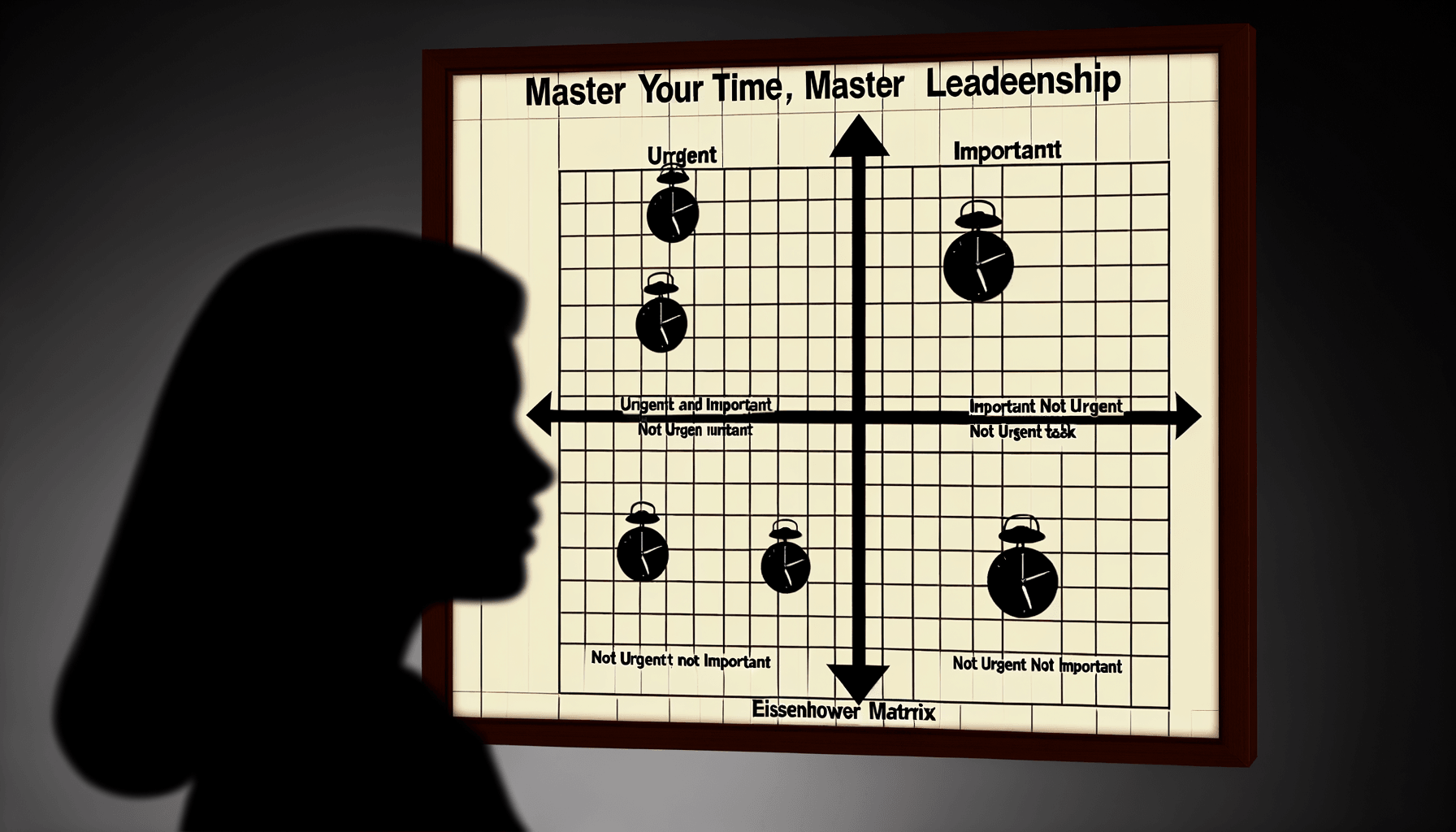
The Eisenhower Matrix is deceptively simple in design but profound in application. It's a 2x2 framework that categorizes every task, project, and decision you face into one of four quadrants based on two variables: urgency (does this need immediate attention?) and importance (does this directly impact my strategic objectives?).
Let's break down each quadrant and what it means for your leadership:
Quadrant 1: Urgent & Important: Crisis Management (DO FIRST)
These are your genuine emergencies. The client who's threatening to walk. The system that's gone down. The compliance issue that just surfaced. The competitive threat that appeared overnight.
Characteristics:
- Demands immediate attention
- Has significant consequences if ignored
- Often involves external deadlines or crises
- Creates stress and high adrenaline
Executive Examples:
- A major customer threatening to terminate their contract
- A key team member announcing their departure mid-project
- A regulatory audit that's been triggered
- A product failure affecting your customer base
- A critical security breach
The Reality: Q1 work is inevitable. Every leader faces genuine crises. The problem isn't that Q1 exists, it's that many executives spend 60-80% of their time here when it should typically be 15-20% of your focused effort.
Q1 attracts your attention because it's visceral. It triggers stress hormones. It feels productive to address it. But here's the critical insight: the size of your Q1 quadrant is largely determined by how much time you invest in Q2.
Quadrant 2: Important & Not Urgent: Strategic Leadership (SCHEDULE—This Is Where Leaders Lead)
This is where the magic happens. This is where you're not reacting to circumstances—you're creating them.
Q2 includes the work that shapes your organization's future, prevents crises before they emerge, and defines your legacy as a leader. It's the strategic planning that prevents market disruption. It's the relationship building that prevents key talent from leaving. It's the systems improvement that prevents the next crisis.
Characteristics:
- No immediate deadline (yet)
- Directly connected to your strategic vision
- Requires deep focus and thoughtful work
- High leverage and impact
- Often preventive in nature
Executive Examples:
- Developing your 2-3 year strategic roadmap
- Building deep relationships with key customers and stakeholders
- Investing in leadership development for your team
- Creating processes and systems that scale
- Staying ahead of industry trends and competitive threats
- Professional development and skill building
- Health, fitness, and family relationships (yes, these belong here too)
Why This Matters Most: Satya Nadella transformed Microsoft from a company in decline to a cloud computing powerhouse by investing massive Q2 effort into cloud strategy when it wasn't yet urgent. The market wasn't demanding it yet. Wall Street wasn't asking for it yet. But Nadella understood that this work—this prevention, this strategic positioning—would determine Microsoft's future. Today, Microsoft's cloud business generates over $80 billion in annual revenue.
That's Q2 work. That's leadership.
Here's the uncomfortable truth that most executives resist: if you're not spending at least 25-30% of your strategic time in Q2, you're not leading—you're managing crises. And you're creating the conditions for more crises tomorrow.
Quadrant 3: Urgent & Not Important: Delegation Gold Mine (DELEGATE)
These are the tasks that scream for attention but don't actually require your executive judgment. The meeting that must happen today but doesn't need you in the room. The report that's due tomorrow but someone else can write it. The email that needs a response but doesn't need your personal involvement.
Characteristics:
- Feels urgent (usually because someone else made it urgent)
- Doesn't require your unique perspective or decision making
- Can be handled effectively by others on your team
- Creates the illusion of productivity
- Often interrupts Q2 work
Executive Examples:
- Status update meetings (can your team lead this?)
- Routine report compilation (can a coordinator handle this?)
- Administrative details (can an assistant manage this?)
- Minor vendor relationships (can a team member own this?)
- Responding to noncritical emails and Slack messages
- Meeting preparation that someone else can do
- Routine project reviews (unless they need your judgment)
The Delegation Opportunity: This is where the 70% delegation rule transforms your leadership capacity. Here's how it works: if someone on your team can do the task 70% as well as you would, delegate it. Not when they can do it 90% as well. Not when they can do it perfectly. When they can do it 70% as well.
Why 70%? Because the 30% gap is vastly outweighed by the benefit of you having time for Q2 work. A slightly imperfect Q3 task is worth 10 hours of your time freed up for strategic work. Do the math on your hourly value as an executive, that trade is always in your favor.
This is how executives who "have no time" suddenly find 10-15 hours per week for strategic work. It's not magic. It's delegation discipline.
Quadrant 4: Neither Urgent Nor Important: Elimination (DELETE)
These are the time wasters. The meetings that have no clear purpose. The reports no one actually reads. The tasks you do out of habit rather than necessity. The activities that feel productive but produce zero value.
Characteristics:
- No deadline pressure
- No strategic value
- Often habitual or traditional
- Creates busy-ness without productivity
- Prevents focus on what matters
Executive Examples:
- Meetings with no clear agenda or decision
- Reports that no one actually uses
- Status updates that could be emails
- Social media scrolling disguised as "staying informed"
- Attending conferences just to attend (vs. strategic learning)
- Maintaining outdated processes because "that's how we've always done it"
- Excessive meeting attendance when your presence adds no value
The Elimination Principle: Every item in Q4 is an opportunity to reclaim time. Senior executives who master the Eisenhower Matrix become ruthless about elimination. "Does this directly support our strategic objectives?" If the answer is no, it gets deleted. It's that simple.
Why the Eisenhower Matrix Matters Right Now
Eisenhower developed this framework 70 years ago, but its relevance has only intensified in the modern executive environment.
The Acceleration Problem
Your world moves faster than ever. The time between when a competitive threat emerges and when it impacts your business has compressed from months to weeks. The pace of organizational change has accelerated. Technology disruption feels constant.
In this environment, waiting for crises to determine your priorities is a formula for irrelevance. You need a framework that lets you stay ahead of the curve. That's Q2 thinking.
The Distraction Problem
Your attention is under assault like never before. Emails, Slack, texts, meetings, notifications they're all competing for your focus. The default mode of modern work is reactive. Without a deliberate framework to push back, you'll spend 100% of your time reacting.
The Eisenhower Matrix is your permission structure to say no to the urgent in favor of the important.
The Opportunity Problem
Every hour you spend on Q3 or Q4 work is an hour you're not spending on strategic initiatives that could fundamentally reshape your organization. The executives pulling away from the pack aren't working longer hours—they're working on different work. They've mastered the Eisenhower Matrix.
Your Step-by-Step Implementation Guide
Let's make this practical. Here's exactly how to implement the Eisenhower Matrix in your leadership practice:
Step 1: The Ruthless Audit (45 minutes)
Before you can organize your work, you need to see it clearly.
Action: Block 45 minutes this week. Pull up your calendar for the past month and your current task list. Write down everything you're actually spending time on. Don't filter it. Don't judge it. Just list it.
For each item, estimate what percentage of your time it consumes. Your goal isn't perfection, it's visibility.
Most executives doing this audit have a moment of clarity: "I'm spending 50% of my time on things I don't actually care about." That's your baseline. Now you can improve it.
Step 2: The Categorization Exercise (60 minutes)
Now comes the hard work: placing each item in the appropriate quadrant.
The Decision Framework:
- Is this critical to my strategic vision for the organization? If no, it's not Q1 or Q2.
- Does this require my unique judgment and authority? If no, it's Q3 (delegate) or Q4 (delete).
- If I don't do this personally, what specifically happens? If nothing bad happens, it's Q3 or Q4.
- What are the consequences of delay? This helps you assess urgency.
Pro tip: Use a simple spreadsheet or whiteboard. Create four columns. Start moving items. You'll likely find:
- 15-20% of your time: Q1 (Crisis Management)
- 25-35% of your time: Q2 (Strategic Leadership) but most executives are closer to 5-10%
- 30-40% of your time: Q3 (Delegation)
- 15-25% of your time: Q4 (Elimination)
Your actual distribution probably looks more like:
- 55% Q1 and Q3 (reactive work)
- 10% Q2 (strategic work)
- 35% Q4 (wasted time)
This is your reality check.
Step 3: The 70% Delegation Rule (Ongoing)
Once you've identified Q3 items, apply the 70% rule ruthlessly.
For each Q3 task, ask:
- "Who on my team could handle this task at 70% of my capability level?"
- "What would I need to teach them or document for them to succeed?"
- "What's the worst that happens if they do this imperfectly, and is that acceptable?"
If the answer to the last question is yes, delegate it. Start this week with 3-5 items.
Track the results: Most executives who implement this properly free up 8-12 hours per week. That's 400+ hours per year. That's transformative.
Step 4: The Time Blocking Strategy (Weekly)
Here's where implementation becomes real: protecting Q2 time.
The System:
- Monday mornings: Block 2 hours for strategic planning and Q2 work. No meetings. No email. No interruptions.
- Wednesday afternoon: Block 2 hours for Q2 work. Deep focus time.
- Friday morning: Block 1 hour for weekly review and Q2 planning for next week.
That's 5 hours per week. For most executives, this more than doubles their Q2 investment and creates immediate impact.
Make this non-negotiable. Treat these blocks like customer meetings. Because they are—they're meetings with your most important client: your organization's future.
Step 5: Digital Tools & Systems (Week 1)
You don't need complex tools, but the right ones help tremendously:
Top Tools for Eisenhower Matrix Management:
- Navigator’s Command Center (CRM): Organize tasks by quadrant, track progress
- Dadan: Simple, taking notes and meeting support
- Reclaim.ai: Automatically protects your Q2 time blocks and coordinates calendar
- Miro: Collaborative whiteboard for team-wide matrix work
- SNOOOZE: Basic but effective approach
Template Approach: Create a simple weekly review template:
- List all new tasks
- Categorize each one (Q1-Q4)
- Assign Q3 items to team members
- Confirm your Q2 blocks are protected
- Identify and delete Q4 items
The Pitfalls That Derail Most Leaders (And How to Avoid Them)
Implementation sounds simple. Execution is where most leaders stumble. Here's what goes wrong, and how to prevent it:
Pitfall 1: The Urgency Trap
What happens: A "crisis" emerges. It feels urgent. You abandon your Q2 work to address it. Then another crisis emerges. And another. Suddenly, you've returned to 100% reactive mode.
Why it happens: Urgency activates our stress response. Our brain treats urgency as importance. We get a neurochemical reward from "solving" the urgent thing.
How to avoid it: Create a crisis filter. Ask: "If I didn't personally handle this today, what actually happens?" If the answer is "nothing critical," it's not Q1. It's Q3 (delegate) or Q4 (delete).
Pitfall 2: Matrix Overload
What happens: You create a matrix with 50 items. It becomes overwhelming. You stop using it.
How to avoid it: Limit yourself to 5-8 items per quadrant. That's maximum. If you have more, it means your categorization is wrong, or you're trying to prioritize items that don't deserve priority.
The whole point is focus. An overloaded matrix defeats the purpose.
Pitfall 3: Mis-categorization
What happens: Something you've labeled Q2 actually isn't strategic. Or something you've labeled Q4 is slowly eroding your business. Your categorization was wrong, so your actions don't deliver results.
How to avoid it: Involve your leadership team in categorization. What you think is Q2 strategic work might not align with organizational priorities. What you think is Q4 waste might be critical to someone else's role.
Spend time discussing: "What do we agree is strategically critical for the next 12-24 months?" Start there. Everything else is supporting detail.
Pitfall 4: Delegation Hesitation
What happens: You've identified Q3 work to delegate, but you hesitate. "It will take longer to teach them than to do it myself." "It's easier if I just handle it." So you don't delegate. You stay trapped.
How to avoid it: Yes, it takes longer to delegate initially. That's true. But here's the math: teaching someone takes 3-4 hours today. But then you've freed up 2-3 hours per week for the next year. That's 100+ hours of your time freed up from a one-time investment.
Apply the 70% rule and be disciplined about it. You're not looking for perfection. You're looking for adequate.
Real World Success Stories: Proof That This Works
These aren't theoretical frameworks. Here's what actually happens when leaders implement Eisenhower Matrix thinking:
Microsoft's Cloud Transformation: Q2 Foresight Reshapes an Industry
When Satya Nadella became CEO of Microsoft in 2014, the company was viewed as a fading technology giant. Nadella faced enormous pressure to show quarterly results. Every stakeholder wanted immediate action on immediate problems.
Instead, he invested massive Q2 effort into cloud computing transformation. The market wasn't screaming for it. Wall Street wasn't demanding it. It wasn't urgent. But it was strategically important.
The result: Today, Microsoft's cloud business (Azure) generates over $80 billion in annual revenue and has become the company's primary growth engine. Nadella's willingness to invest in Q2 work when the urgency trap would have pulled him elsewhere fundamentally reshaped a $2 trillion company.
That's the power of strategic leadership over crisis management.
Debt Consolidation Organization: 46% Reduction in Client Drop-off
A US debt consolidation organization implemented systematic Q2 work focused on proactive client outreach and prevention of default situations. Instead of reacting to clients who were about to leave, they invested time in relationship-building and early intervention.
The measurable result: Client drop-off rates fell by 46% within 12 months. They weren't doing more work, they were doing different work. They shifted from reactive crisis management to proactive prevention.
On a $50 million revenue business, a 46% reduction in churn translates to millions of dollars in recovered revenue. And it came from Q2 discipline.
Executive Stress & Work Life Balance: The Unexpected Benefit
We often present the Eisenhower Matrix as a productivity tool. But something unexpected happens when executives implement it properly: their stress drops dramatically, and their work-life balance improves.
Why? Because the urgency trap doesn't just consume time, it consumes emotional energy. When you're constantly firefighting, your nervous system stays in crisis mode. Cortisol stays elevated. You're exhausted at the end of each day, even though you didn't accomplish anything strategic.
When you move from 80% reactive (Q1/Q3) to 30% reactive, you're no longer living in crisis mode. You return to focus, to strategy, to impact. And paradoxically, your work becomes less demanding even as your impact increases.
Executives implementing this framework consistently report reduced stress and better personal relationships. The framework isn't just about productivity, it's about sustainable, fulfilling leadership.
The Often Forgotten Quadrant: Why Your Personal Life Belongs in the Matrix
Here's something most productivity frameworks miss: the Eisenhower Matrix applies equally to personal priorities as to professional ones.
Your health. Your family relationships. Your professional development. Your spiritual or personal growth. These belong in your matrix too.
Why this matters: An executive who's mastered professional Q2 but neglects personal Q2 will eventually burn out. You can't sustain high performance indefinitely if you're neglecting your health, your closest relationships, or your own development.
How to integrate personal priorities:
- Health & Fitness (Q2): Schedule it as seriously as you schedule customer calls. 45 minutes three times per week. Non-negotiable.
- Meaningful Relationships (Q2): Schedule date nights. Schedule one-on-one time with your kids. Put it on the calendar with the same protection as your Q2 professional time.
- Professional Development (Q2): Reading, learning, skill-building. Not someday. Now. During your Q2 blocks.
The executives with the greatest long-term impact treat personal Q2 work with the same discipline as professional Q2 work. They understand that sustainable leadership requires sustainable living.
Your 4 Week Implementation Blueprint
Stop reading. Start implementing. Here's your exact roadmap:
Week 1: Audit and Categorization
Time required: 3 hours
Actions:
- Monday: 45 minute ruthless audit (everything you spend time on)
- Wednesday: 60 minute categorization exercise (place items in Q1-Q4)
- Friday: 15 minute review and reflection
Outcome: You now see clearly where your time actually goes versus where you think it goes.
Deliverable: A spreadsheet or written list with each task/project categorized Q1-Q4.
Week 2: Systems and Delegation Setup
Time required: 4 hours
Actions:
- Monday: Select your digital tool (Snoooz, Dadan, or Navigators Command Center (CRM))
- Tuesday: Set up your Q1-Q4 framework in your chosen tool
- Wednesday: Identify 5-10 Q3 items to delegate; have delegation conversations with team members
- Thursday: Set up your weekly Q2 time blocks (Monday, Wednesday, Friday)
- Friday: Create your weekly review template and schedule a recurring Friday 1-hour review
Outcome: Your system is built. Your Q2 time is protected. Delegation is beginning.
Deliverable: Functional task management system and protected calendar blocks.
Week 3: First Execution Cycle
Time required: Ongoing, but you should notice immediate differences
Actions:
- Protect your Q2 time blocks religiously. Don't skip them.
- Execute on Q3 delegation. Follow up with team members but resist taking back work.
- Begin deleting Q4 items. Notice where you feel guilt (often these aren't actually important).
- Tackle some Q1 items with full focus during designated times.
- Friday review: What worked? What didn't?
Outcome: You're actually operating in the new system. You're likely feeling more focused and less scattered.
Deliverable: First week of results, even if modest.
Ongoing: Monthly Review and Refinement
Time required: 1 hour per month
Process:
- First Friday of each month: Comprehensive review
- Recategorize items (urgency and importance shift)
- Adjust Q2 focus based on strategic shifts
- Celebrate delegation wins
- Identify new Q4 items to eliminate
- Prepare Q2 focus for next month
Outcome: Your matrix stays alive and relevant as your priorities evolve.
Common Misconceptions: What Leaders Get Wrong About Eisenhower
Before we wrap up, let's clear up the myths that might hold you back:
Myth 1: "All urgent things are Q1." Reality: Urgent ≠ Important. Most "urgent" requests are Q3 (someone else made them urgent) or Q4 (they're not important to your goals).
Myth 2: "I should spend most of my time on Q1." Reality: Q1 should consume 15-20% of your time. If you're spending 60%+ on Q1, your Q2 investment is too low and you're creating crises.
Myth 3: "Q2 work can wait indefinitely." Reality: Q2 is where crises are prevented. Neglect Q2, and you guarantee a future of Q1 firefighting. It's the most time-sensitive quadrant, even though nothing feels urgent about it today.
Myth 4: "Delegation means I'm avoiding work." Reality: Delegation is force multiplication. It's how leaders scale their impact. Using the 70% rule, you're making a strategic trade: 30% quality loss on a Q3 task in exchange for hours of Q2 time. That's powerful mathematics.
Your Competitive Advantage: Strategic vs. Reactive Leadership
Here's the truth that separates the leaders pulling ahead from those getting left behind:
The average executive is trapped in reactive mode. They're busy. They're overwhelmed. They're managing crises. And because they never invest in Q2, they're guaranteed a future of crisis management.
The exceptional leaders? They've mastered the shift from reactive to strategic. They've built systems that handle Q1 and Q3 efficiently, which frees time for Q2. They've created organizations where people are delegated to and developed, rather than constantly emergency-pulled in to solve crises.
Those leaders move their organizations forward. They set strategy instead of reacting to circumstances. They build cultures of prevention instead of cultures of crisis. They achieve work-life balance instead of burnout.
The Eisenhower Matrix is the framework that makes this shift possible. But frameworks are only valuable if you implement them.
Let's Transform Your Leadership Together
The Eisenhower Matrix isn't a new idea. But its application to modern executive leadership? That's where the transformation happens.
You now understand the framework. You've seen the implementation roadmap. You know what success looks like.
The question is: Are you ready to move from being busy to being strategic?
Here's what we recommend:
Start with Week 1. Do the audit. Do the categorization. Spend three hours seeing your current reality clearly.
If you want deeper support or if you want to work with a team that specializes in helping senior executives master this framework and build organizations around strategic thinking. The Business Navigators Consulting Services is here to help.
We offer:
- Eisenhower Matrix Assessment: A comprehensive review of how you and your leadership team are currently allocating time and where strategic opportunities lie
- Implementation Workshop: Hands-on facilitation of the matrix setup and delegation planning with your team
- Executive Coaching: 90-day transformation programs where we help you build the habits and systems that stick
- Organization-Wide Alignment: If you want your entire leadership team thinking in Q2, we help create that alignment
Your next step: Schedule a brief conversation with our team. We'll ask you three questions:
- What percentage of your time currently goes to strategic Q2 work?
- What would be possible for your organization if that percentage doubled?
- What's preventing that shift from happening today?
From there, we'll either share specific tools you can implement immediately, or we'll discuss how a deeper partnership might accelerate your transformation.
Ready to shift from reactive to strategic?
Schedule Your Strategy Conversation with Business Navigators Consulting Services
The matrix is simple. The discipline is the difference. And we're here to help you master both.
Business Navigators Consulting Services specializes in helping senior executives and leadership teams move from crisis management to strategic leadership. The Eisenhower Matrix is our foundation. Your organization's transformation is our mission.